Village

Abbey Dore

A village grew around a French-founded abbey whose working landscape survives in earthworks, while its eastern church became a place of parish worship and music.

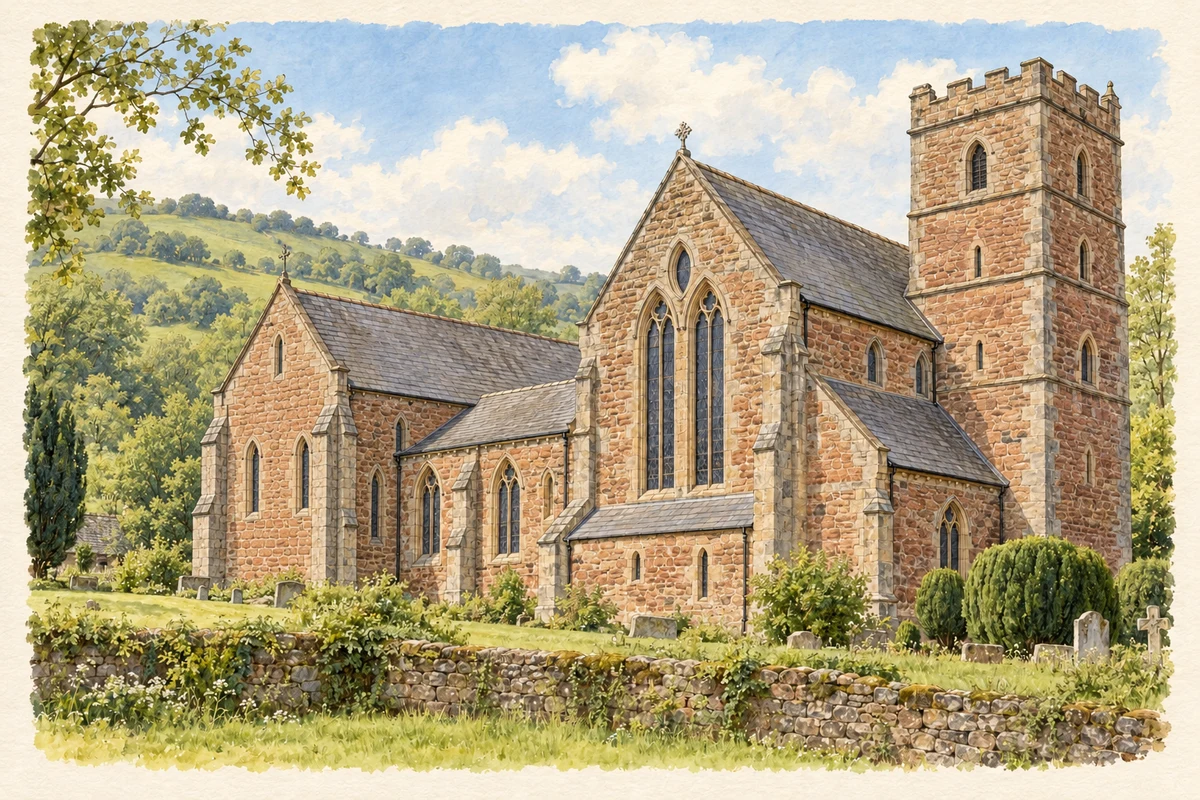
Watercolour and fine ink illustration of Dore Abbey parish church
Illustration · Dore Abbey parish church
Original illustration; researched sources
Research sources

Original architectural composition based on the cited building descriptions; incidental setting and fine details are interpretive.

Historic England: Dore Abbey Church of St Mary; Dore Abbey

History & heritage

Place & story

A village formed around a monastery

Abbey Dore’s parish church is the surviving eastern end of a much larger monastery. Founded in 1147 under the patronage of Robert Fitz Harold of Ewyas, Dore was settled by monks from Morimond in north-eastern France. The village grew around the abbey, and its name still identifies a community whose central building began as part of an international religious order. [2]

The abbey stands above the River Dore’s floodplain in a steep-sided valley. Its cloister was built north of the church, probably because the slope restricted space on the more usual southern side. The principal buildings went up between the middle of the twelfth century and about 1210. The landscape helped determine how the monks arranged their daily life. [3]

Wool, work and water

Dore’s economy reached well beyond the valley. Historian Ruth Richardson describes sheep farming on outlying granges and high-quality wool sold as far away as Italy. Lay brothers worked on these farms and had separate accommodation and a separate part of the church. The monastery therefore depended on a division of work as well as a shared religious purpose. [4]

The earthworks preserve another working landscape. A main drain passed beneath the lavatories, kitchens and infirmary before continuing as a leat. Nearby are remains interpreted as a mill and interconnected fishponds. These identifications retain some uncertainty, but they show why the monastery must be understood through water supply, food and sanitation as well as its church. [3]

A larger church than first appears

The present building comprises the presbytery, crossing and transepts, much of them twelfth- and thirteenth-century work. The vanished nave occupied ground now used as the churchyard. Outside, surviving masonry and low banks allow the outline of the lost church to be followed. What appears today as a complete parish church is a selected portion of a much greater complex. [5] [3]

The interior also resists the idea that a Cistercian church was permanently bare. Richardson records painted and gilded foliage on capitals, stained glass, tiles and carved roof bosses. Effigies and the gift of a Holy Cross relic in 1321 connect the abbey with local patrons and devotional visitors. Its medieval religious life included colour, commemoration and valuable objects. [4]

From monastic property to parish church

Dore was suppressed in 1536, according to Historic England and the abbey’s own account. Its buildings were sold and much of their fabric dismantled. The church later received a new role through Viscount Scudamore’s restoration in the 1630s. The seventeenth-century tower, carved oak fittings, screen and stained glass belong to this conversion into an Anglican parish church. [2] [5] [3]

Restoration reused material from the ruined monastery, including carved roof bosses. A wooden musicians’ gallery was added in the early eighteenth century. Further rescue was necessary by the end of the nineteenth century; the abbey dates Roland Paul’s repairs to 1901–09. The building’s survival resulted from repeated choices about what to repair, retain and use. [5] [2]

The abbey remains a parish church, with services marking baptisms, marriages and funerals, alongside concerts, choral workshops and other arts events. Its surviving medieval spaces have acquired a community life much wider than their original monastic function. [2]

Back to contents
Lives connected to this place

Notable people

John, Viscount Scudamore: restoring an inheritance

Scudamore’s connection with Dore was as owner and patron of its seventeenth-century rescue. Richardson relates his concern over income inherited from former church lands and his association with Archbishop William Laud. His restoration reshaped the surviving church for Anglican worship; the church was reconsecrated during the 1630s. [4]

Roland Paul: recording the vanished abbey

Roland Paul combined restoration with archaeological recording. Between 1895 and 1904 he excavated parts of the nave, cloister buildings and precinct and made measured drawings. His work helped establish the monastery’s plan, allowing the buried and fragmentary buildings to be read alongside the church that remained in use. [3]

Back to contents
A chronology

Timeline

Abbey Dore through time

  1. 1147 — Monks from Morimond establish Dore Abbey under Robert Fitz Harold’s patronage. [2]

  2. 1321 — William de Gradisson gives Abbot Richard a relic of the Holy Cross. [2]

  3. 1536 — The abbey is suppressed. [3]

  4. 1630s — Scudamore restores the surviving church for parish worship. [5]

  5. 1895–1904 — Roland Paul excavates and records the monastic remains. [3]

  6. 1901–09 — Further church repairs are undertaken by Paul. [2]

Back to contents

Population over time

A verified population series for Abbey Dore as a settlement has not yet been added. Neighbourhood census figures are available below.

Neighbourhood census context

These figures describe statistical neighbourhoods, which may cover part of a place or include neighbouring places.

Neighbourhood census area · 1971–2021

Herefordshire 020

Population of the area containing the recorded point for Abbey Dore, not the whole place. This area may cover part of the place or include neighbours.

01.8k3.5k5.3k7k1971: 4,630 people19711981: 5,059 people19811991: 5,253 people19912001: 5,811 people20012011: 6,067 people20112021: 6,060 people2021

Includes harmonised historical census estimates.

Sources: ONS · Paul Norman

View population figures
Herefordshire 020 — census population and harmonised historical estimates
Census yearPopulation
19714,630
19815,059
19915,253
20015,811
20116,067
20216,060
Sources and how to read this chart

Usual residents of the containing MSOA; this is local area context, not the population of the named settlement.. Boundary geography: 1 April 2022 (E02002924).

2011 and 2021 census counts harmonised by ONS to the same 1 April 2022 geography. Location matched to ONS 2021 MSOA polygons (full resolution, coastline clipped, V7). ONS exact-fit lookup marks this MSOA unchanged from 2011 (U); historical estimates use that same footprint.

1971–2011: Paul Norman harmonised historical estimates on 2011 MSOAs, rounded to whole residents (1971–1991 are modelled). 2021: ONS census count. The historical 2011 total can differ slightly from the ONS change-over-time 2011 total because of methodology and statistical disclosure controls. These are area estimates, not settlement totals.

Source: ONS Census change over time: usual resident population, 2011 and 2021. Open Government Licence v3.0. Retrieved 2026-10-26. Source: ONS MSOA December 2021 boundaries EW BFC V7. Open Government Licence v3.0. Retrieved 2026-10-26. Source: Paul Norman — Area characteristics: Great Britain 1971 to 2011. Creative Commons Attribution 4.0. Retrieved 2026-10-26. Source: ONS MSOA 2011 to MSOA 2021 exact-fit lookup for England and Wales. Open Government Licence v3.0. Retrieved 2026-10-26.

Recorded locationAbbey Dore51.96946° N · 2.89607° WInteractive map loads when this area enters view.
Approximate recorded location · Geographic source

Geographic context

Place type
Village
Country / region
England · West Midlands
County group
Herefordshire
Current administration
County of Herefordshire
Recorded coordinates
51.96946, -2.89607
OS Open Names ID
osgb4000000074579644

County groups are browsing aids. Current administrative and historic areas are recorded separately.

Recorded names

  • Abbey Dore · en · official

Nearby heritage

Distances are from the recorded place point. Proximity does not establish that a site lies within the place boundary or belongs to its history.

Sources & further reading

  1. OS Open Names October 2026 · Source licence.
  2. Dore Abbey: Ancient Monument · Dore Abbey
  3. Dore Abbey: a Cistercian monastery, 1016433 · Historic England
  4. Dore Abbey · Ruth E. Richardson / Herefordshire Archaeology
  5. Dore Abbey, Abbeydore · National Churches Trust
  6. Original illustration of Dore Abbey parish church by PlaceHistory. Researched sources are linked beneath the illustration. Original composition from inspected architectural facts; no source photograph copied or used as an image-edit input. Fine detail is interpretive, not a measured survey.

Geographic source retrieved 2026-10-26. History last researched 2026-10-26. How this page was prepared.