City

Stoke-on-Trent

Six pottery towns became one municipality in 1910. Factory organisation, workers’ homes and the effort to preserve skills give the city a history beyond its celebrated ceramic names.

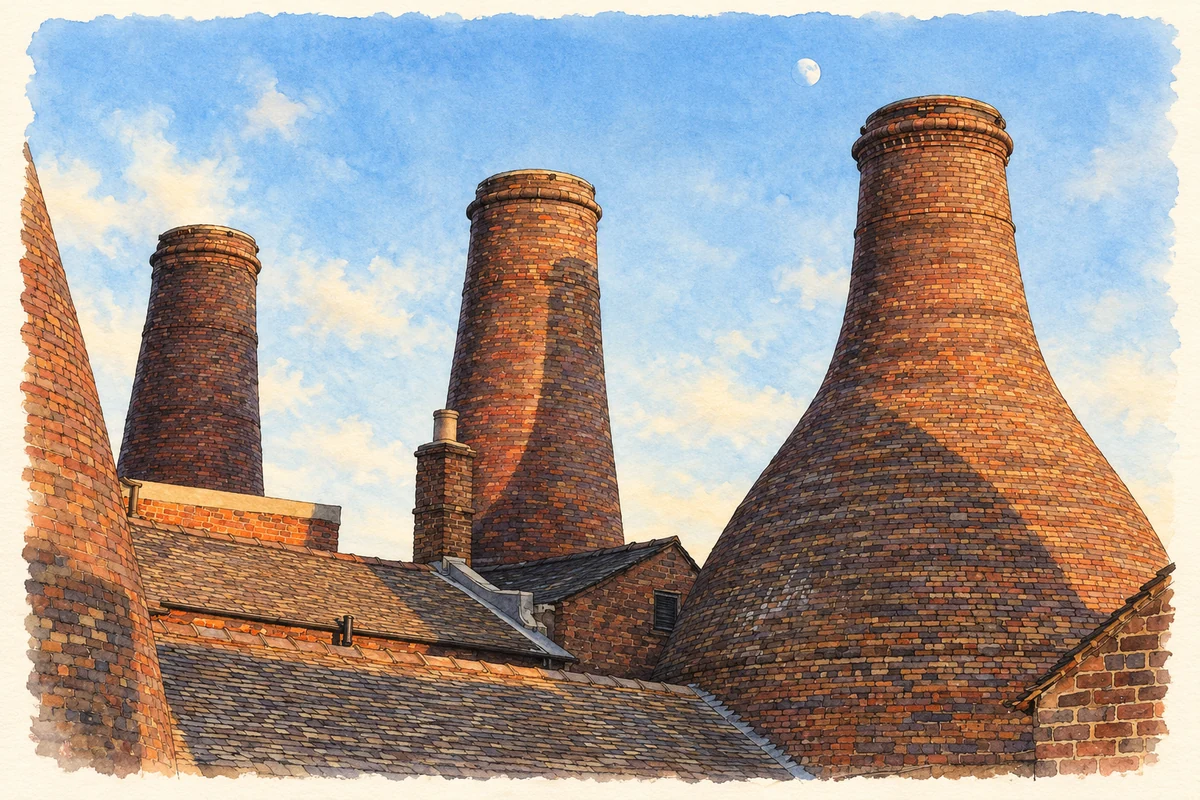
Watercolour and fine ink illustration of Gladstone Pottery Museum bottle ovens, Longton
Illustration · Gladstone Pottery Museum bottle ovens, Longton
History & heritage

Place & story

One city with several centres

Stoke-on-Trent brings together Tunstall, Burslem, Hanley, Stoke-upon-Trent, Fenton and Longton. The council’s 2004 community strategy describes a linear city stretching between its northern and southern towns. Stoke is therefore both one of the six constituent towns and part of the name of the larger city; the two meanings should not be confused. [3]

Federation in 1910 created the combined municipality, but city status followed only in 1925. An initial application failed because the population was below the Home Office’s usual threshold. A direct approach to George V succeeded, and recognition came on 5 June 1925. The council’s account associates that recognition with the district’s contribution to pottery manufacture. [2]

Materials, design and routes to market

The ceramics that made the Potteries famous were products of repeated experiment as well as inherited craft. The V&A describes Wedgwood’s thousands of glaze and body trials, improving cream-coloured earthenware for a growing consumer market. Fashionable design and relatively affordable production worked together; the area’s achievement cannot be explained solely by the availability of raw materials. [4]

Moving heavy materials and fragile pots was expensive on poor roads. Wedgwood helped promote the Trent and Mersey Canal, completed in 1777. It passed his purpose-built Etruria works, where production was arranged in a planned sequence and workers’ housing stood nearby. Canal transport, factory layout and the management of labour belonged to the same commercial system. [4]

The people inside the potbank

The Wedgwood archive brings work and home into the same story. Hamlet Wood, apprenticed as a counting-house clerk in 1789, helped manage property and collect rents at Etruria. His correspondence discusses poor tenants and the competing demand for a workman’s house. Other letters describe his wife’s difficulty with a muddy doorway and a dispute over using spare tiles to improve it. A factory community involved domestic negotiations as well as manufacture. [5]

Industrial success also carried bodily costs. Clare Holdsworth’s research into North Staffordshire between 1890 and 1914 identifies lead and dust as principal hazards for pottery workers and examines the legislation intended to reduce them. Her study gives particular attention to women and the different ways regulation treated male and female workers. Health was part of the industry’s organisation and political history. [6]

Two ways of keeping industrial skills

At Middleport, Burgess & Leigh’s factory was built in 1888 with the production processes placed in order. Historic England’s interview with its heritage manager explains the resulting reputation as a model pottery. The layout is evidence of industrial planning, while the continued hand processes connect the buildings to learned skills rather than making them merely a shell to admire. [7]

The National Lottery Heritage Fund records a serious threat when repair costs made relocation attractive. The Prince’s Regeneration Trust bought the site in 2011; its rescue kept pottery production in part of the buildings while adapting other spaces for workshops, galleries and visitors. Preservation here depended on accommodating work and new activity together. [8]

Gladstone in Longton tells a complementary story. It made ordinary ceramic goods for a mass market, typical of many smaller factories rather than a famous luxury brand. Its original workshops and demonstrations explain the work of men, women and children, including throwing, decoration and bone-china flower making. This makes everyday manufacture visible alongside the better-known designers and companies. [9]

The museum grew through practical work by volunteers, many with pottery-industry connections. A preview season in 1974 helped prepare for the official opening in 1975. The council’s anniversary account remembers maintaining equipment as well as welcoming visitors: preserving a working industry required people who could care for its machinery and pass on their knowledge. [10]

Back to contents
Lives connected to this place

Notable people

Josiah Wedgwood and Thomas Bentley: launching Etruria

Wedgwood opened Etruria in 1769. To mark the occasion he threw six basalt vases while his business partner Thomas Bentley powered the wheel. The surviving First Day’s Vases connect an industrial venture with a particular act of skilled making. The Art Fund’s account follows the pots onwards to the partnership’s London decorating workshop, showing how production already crossed local boundaries. [11]

Hamlet Wood: a clerk’s working life

Wood’s seven-year apprenticeship began on 11 November 1789, with first-year pay of two shillings a week. His father William was a Wedgwood modeller. Hamlet’s later responsibilities included accounts, correspondence and property matters, revealing another kind of Potteries skill alongside the work at the wheel and kiln. [5]

Arnold Bennett: remembering the Potteries in fiction

Bennett was born in Hope Street, Hanley, in 1867 and educated in Burslem and Newcastle-under-Lyme. He later became a successful author and journalist, setting much of his best-known fiction in a disguised version of the Potteries called the Five Towns. That literary geography should be distinguished from the six towns of the actual city. His ashes are buried in Burslem Cemetery. [12]

Back to contents
A chronology

Timeline

Stoke-on-Trent through time

  1. 1769 — Wedgwood and Bentley mark the opening of Etruria with the First Day’s Vases. [11]

  2. 1777 — The Trent and Mersey Canal is completed. [4]

  3. 1789 — Hamlet Wood begins his counting-house apprenticeship. [5]

  4. 1888 — Burgess & Leigh build the Middleport factory. [7]

  5. 1910 — The six towns unite in one municipality. [3]

  6. 5 June 1925 — Stoke-on-Trent receives city status. [2]

  7. 1975 — Gladstone Pottery Museum officially opens. [10]

  8. 2011 — The Prince’s Regeneration Trust purchases Middleport Pottery. [8]

Back to contents

Population over time

Built-up area · Settlement · Census 2021

Stoke-on-Trent

260,560people · 2021

Census 2021 population of the named settlement, using ONS built-up area boundaries.

Published census counts.

Sources: ONS: Towns and cities, characteristics of built-up areas, Census 2021 (Table 1c)

View population figures
Stoke-on-Trent — census population
Census yearPopulation
2021260,560
Sources and how to read this chart

Usual residents on 21 March 2021; published ONS count rounded to the nearest 5.. Boundary geography: December 2022 (E63001958).

Census 2021 population of the named settlement, using ONS built-up area boundaries.

ONS Table 1c rounds counts to the nearest 5 and suppresses counts below 10. Matched by exact settlement name or individually reviewed district-qualified name, with its coordinate strictly inside that same official BUA boundary. The 2022 BUA geography changed methodology and cannot be directly compared with 2011 BUAs. Contains OS data © Crown copyright and database right 2026. Contains National Statistics data © Crown copyright and database right 2026.

Source: ONS: Towns and cities, characteristics of built-up areas, Census 2021 (Table 1c). Open Government Licence v3.0. Retrieved 2026-10-26. Source: ONS and Ordnance Survey: Built Up Areas December 2022 GB BGG. Open Government Licence v3.0. Retrieved 2026-10-26.

Neighbourhood census context

These figures describe statistical neighbourhoods, which may cover part of a place or include neighbouring places.

Neighbourhood census area · 1971–2021

Stoke-on-Trent 016

Population of the area containing the recorded point for Stoke-on-Trent, not the whole place. This area may cover part of the place or include neighbours.

05k10k15k20k1971: 11,903 people19711981: 9,400 people19811991: 9,348 people19912001: 9,350 people20012011: 9,048 people20112021: 10,329 people2021

Includes harmonised historical census estimates.

Sources: ONS · Paul Norman

View population figures
Stoke-on-Trent 016 — census population and harmonised historical estimates
Census yearPopulation
197111,903
19819,400
19919,348
20019,350
20119,048
202110,329
Sources and how to read this chart

Usual residents of the containing MSOA; this is local area context, not the population of the named settlement.. Boundary geography: 1 April 2022 (E02002966).

2011 and 2021 census counts harmonised by ONS to the same 1 April 2022 geography. Location matched to ONS 2021 MSOA polygons (full resolution, coastline clipped, V7). ONS exact-fit lookup marks this MSOA unchanged from 2011 (U); historical estimates use that same footprint.

1971–2011: Paul Norman harmonised historical estimates on 2011 MSOAs, rounded to whole residents (1971–1991 are modelled). 2021: ONS census count. The historical 2011 total can differ slightly from the ONS change-over-time 2011 total because of methodology and statistical disclosure controls. These are area estimates, not settlement totals.

Source: ONS Census change over time: usual resident population, 2011 and 2021. Open Government Licence v3.0. Retrieved 2026-10-26. Source: ONS MSOA December 2021 boundaries EW BFC V7. Open Government Licence v3.0. Retrieved 2026-10-26. Source: Paul Norman — Area characteristics: Great Britain 1971 to 2011. Creative Commons Attribution 4.0. Retrieved 2026-10-26. Source: ONS MSOA 2011 to MSOA 2021 exact-fit lookup for England and Wales. Open Government Licence v3.0. Retrieved 2026-10-26.

Recorded locationStoke-on-Trent53.02218° N · 2.17337° WInteractive map loads when this area enters view.
Approximate recorded location · Geographic source

Geographic context

Place type
City
Country / region
England · West Midlands
County group
Staffordshire
Current administration
City of Stoke-on-Trent
Recorded coordinates
53.02218, -2.17337
OS Open Names ID
osgb4000000074575785

County groups are browsing aids. Current administrative and historic areas are recorded separately.

Recorded names

  • Stoke-on-Trent · en · official

Nearby heritage

Distances are from the recorded place point. Proximity does not establish that a site lies within the place boundary or belongs to its history.

Sources & further reading

  1. OS Open Names October 2026 · Source licence.
  2. Stoke-on-Trent: Celebrating 100 years as a city · Stoke-on-Trent City Council
  3. Stoke-on-Trent Community Strategy 2004–14 · Stoke-on-Trent City Council
  4. Wedgwood: An introduction · Victoria and Albert Museum
  5. Another brick in the wall? Tracing the story of Hamlet Wood through the V&A Wedgwood Collection · Lucy Lead, Archivist, V&A Wedgwood Collection
  6. Potters’ Rot and Plumbism: Occupational Health in the North Staffordshire Potteries, 1890 to 1914 · Clare Holdsworth, University of Liverpool
  7. 100 Places Podcast 31: Pottery and Coal · Historic England
  8. Saving Middleport Pottery · The National Lottery Heritage Fund
  9. Gladstone Pottery Museum · Visit Stoke
  10. Gladstone Pottery Museum all fired up to celebrate golden anniversary · Stoke-on-Trent City Council
  11. First Day’s Vase · Art Fund
  12. Arnold Bennett, resource 49856 · Staffordshire Past Track / Trustees of the William Salt Library
  13. Illustration of Gladstone Pottery Museum bottle ovens, Longton, adapted from Gladstone Pottery Museum, Longton - Bottle kilns. - geograph.org.uk - 4274282.jpg by Colin Park. CC BY-SA 2.0. AI-assisted watercolour and fine ink adaptation; incidental clutter simplified, warm cream paper margins. Architectural forms follow the inspected reference.

Geographic source retrieved 2026-10-26. History last researched 2026-10-27. How this page was prepared.