 place
Staffordshire
The Potteries and Burton's breweries sit alongside Stafford's county-town history, Lichfield's cathedral and coaching routes, and the worked landscape of Cannock Chase.
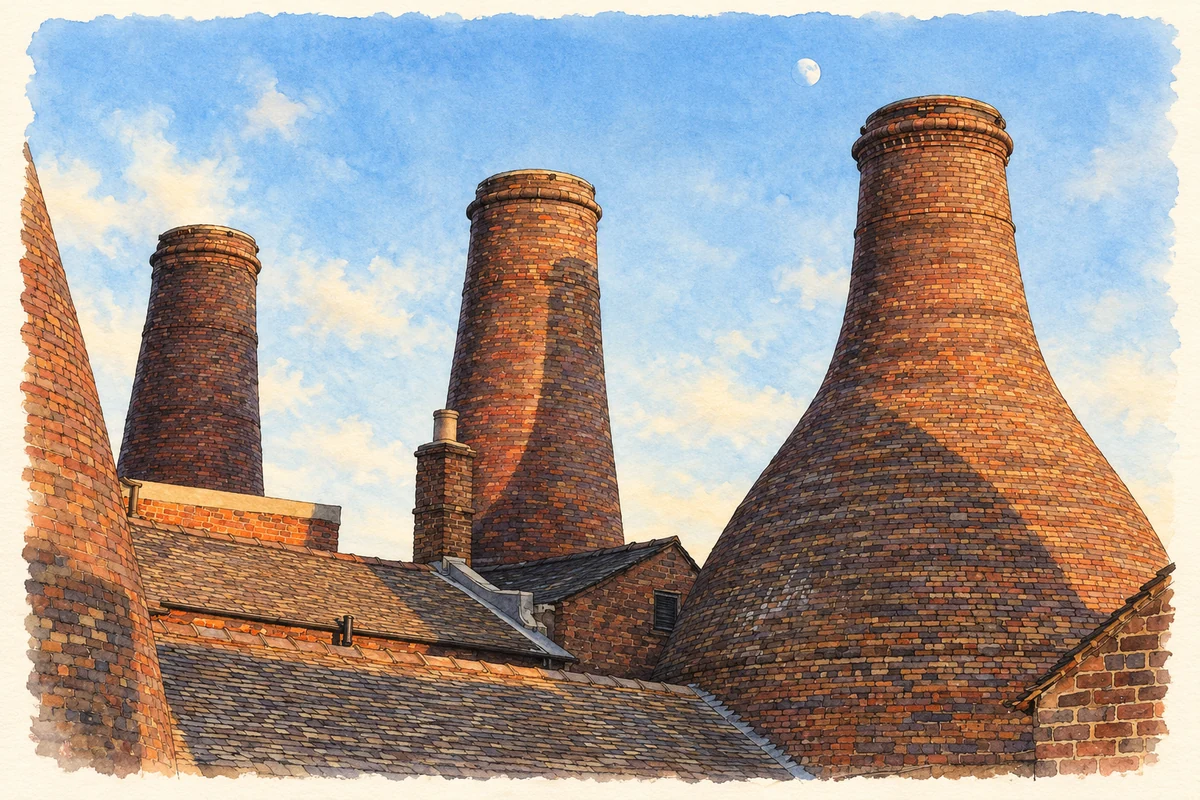
Illustration credit
Illustration of Gladstone Pottery Museum bottle ovens, Longton, adapted from Gladstone Pottery Museum, Longton - Bottle kilns. - geograph.org.uk - 4274282.jpg by Colin Park. CC BY-SA 2.0. AI-assisted watercolour and fine ink adaptation; incidental clutter simplified, warm cream paper margins. Architectural forms follow the inspected reference.

A history of Staffordshire
A county guide across council boundaries
This guide groups Staffordshire with Stoke-on-Trent, while keeping their local government distinct. Stoke-on-Trent City Council is a unitary authority; elsewhere, services are divided between Staffordshire County Council and district or borough councils. The grouping is a way into the area's history, rather than a reconstruction of historic county boundaries. Readers using old records should keep the date and jurisdiction of each document in view. [2]
Council arrangements are also a moving subject. On 7 September 2026 the government paused the local government reorganisation process for Staffordshire and Stoke-on-Trent. Lichfield District Council's subsequent explanation says that the July proposals are under review and that existing councils continue to operate. A proposed future authority should therefore not be treated as an established geography when reading these histories. [2] [3]
Stafford: defence, markets and manufacture
Stafford's position as county town has deep roots. The borough council's history dates Æthelflæd's fortified burh to 913 and describes it as part of a chain of defences that included Tamworth and Chester. The town later had a mint and made pottery known as Staffordware. Its medieval economy included a market dealing in cloth and wool. These activities connect the administrative centre with the production and exchange of ordinary goods. [4]
Later manufacturing gave Stafford another identity. William Horton helped establish its shoe industry in the eighteenth century, while the nineteenth-century railway era was associated with firms including Bagnalls, Dorman Diesels and the works associated with Siemens and English Electric. Reading Stafford alongside the Potteries therefore reveals several forms of industrial specialisation within the wider county. The present borough is itself a later creation, formed by the merger of four authorities in the 1974 reorganisation. [4]
The Potteries: experiment and distribution
North Staffordshire's ceramics story brings together skilled manufacture, changing taste and transport. Josiah Wedgwood founded his business in 1759 in a region already containing many family potteries. His extensive trials refined cream-coloured earthenware into an affordable competitor to porcelain. Royal patronage helped market it as Queen's ware, while Jasperware offered a different material suited to fashionable classical decoration. These products emerged from a working industry with many hands, rather than from design alone. [5]
Moving fragile wares and bringing in raw materials mattered to the business. Wedgwood supported the Trent and Mersey Canal, completed in 1777, which connected Staffordshire to the ports of Liverpool and Hull. It passed his purpose-built Etruria factory, where production processes and workers' housing were deliberately planned. The V&A's account traces a later move to rural Barlaston in the twentieth century: the company's geography changed as well as its designs. [5]
The modern city's creation was another distinct stage. Six towns federated as Stoke-on-Trent in 1910, but city status followed only on 5 June 1925. The difference between federation and city status helps explain why older town identities and the collective city name both appear in local histories. The council's centenary account links the honour to the area's contribution to pottery manufacture. [6]
Lichfield: a cathedral and a coaching city
Lichfield offers a contrasting urban history. Chad moved his bishopric there in 669, and the city developed as an ecclesiastical centre of Mercia. In the twelfth century Bishop Clinton fortified the Close and laid out the ladder-shaped street plan. During the Civil War the fortified Close made the city strategically important; the cathedral's central spire collapsed under bombardment in 1646. Church buildings here were entangled with urban planning, property and warfare. [7]
Rebuilding followed the appointment of Bishop Hacket in 1662. In the eighteenth century Lichfield prospered through the clergy and gentry of the Close and through coaching traffic on the route towards the northwest and Ireland. Its cultural history includes Samuel Johnson, Erasmus Darwin and Anna Seward. The arrival of railways ended its role as a coaching hub, showing how a railway could reduce the importance of an older road-based trade. [7]
Burton's brewing enterprise
Burton upon Trent provides another example of a specialised manufacturing town. William Bass established his brewery on High Street in 1777, after working in the transport of beer. The business developed an international market for pale ale, and its red triangle became a lasting commercial emblem. East Staffordshire Borough Council's heritage account also connects Bass House with plans to preserve and explain brewing archives. Brewing history can be approached through the buildings and records of production as well as through the drink itself. [8]
Cannock Chase: countryside shaped by work
Cannock Chase combines a plateau of heathland and woodland with smaller fields, hedgerows and lanes around its fringes. Its landscape has a substantial human history. The Chase Through Time project used aerial photographs and laser scanning to map prehistoric traces, medieval and later coal workings, post-medieval land divisions and First World War remains. Woodland and open heath can conceal the evidence of earlier industries and military use. They invite a different kind of historical reading from a town street or factory building. [9] [10]
Places and their stories
A few of the 35 researched histories in this county.
- City
Stoke-on-Trent
Illustration credit
Illustration of Gladstone Pottery Museum bottle ovens, Longton, adapted from Gladstone Pottery Museum, Longton - Bottle kilns. - geograph.org.uk - 4274282.jpg by Colin Park. CC BY-SA 2.0. AI-assisted watercolour and fine ink adaptation; incidental clutter simplified, warm cream paper margins. Architectural forms follow the inspected reference.
 City
Lichfield
Illustration credit
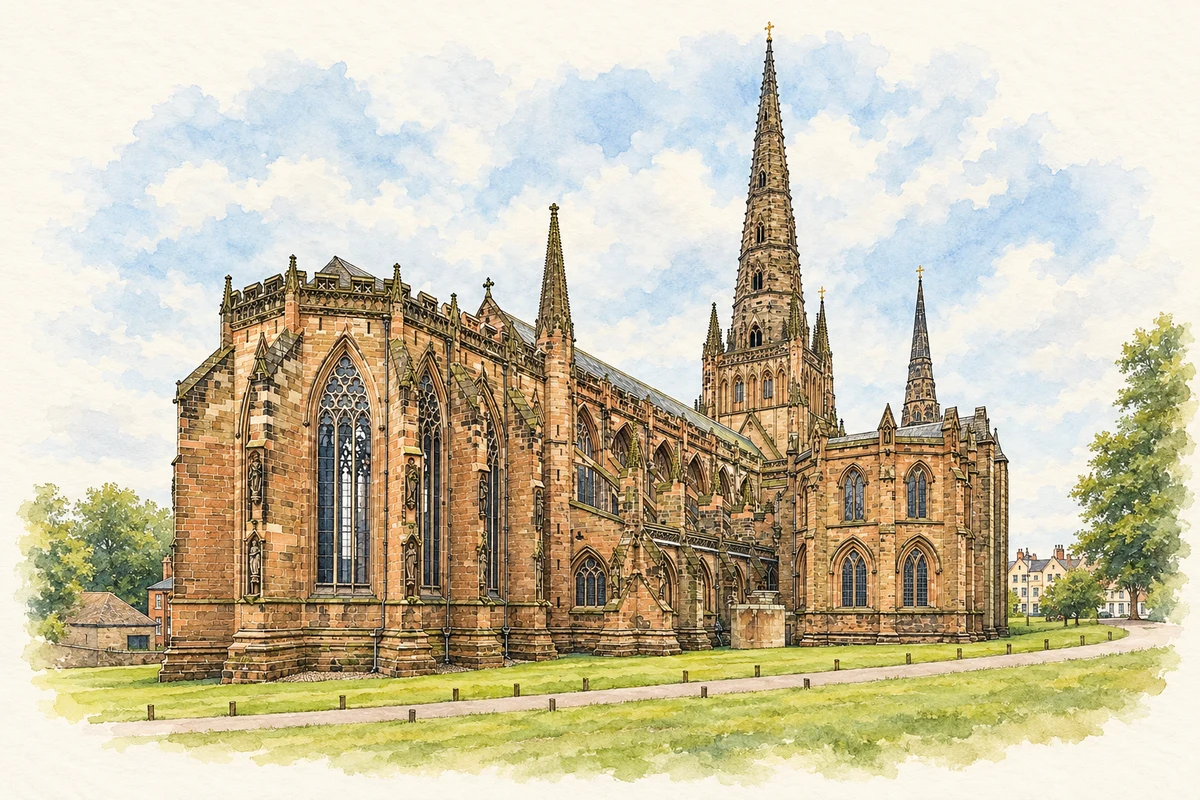
Illustration of Lichfield Cathedral, adapted from Lichfield Cathedral Exterior from NE, Staffordshire, UK - Diliff.jpg by Diliff. CC BY-SA 3.0. AI-assisted watercolour and fine ink adaptation; cream paper margins, simplified fine detail and removal of incidental street clutter.
 Town
Burton upon Trent
Illustration credit
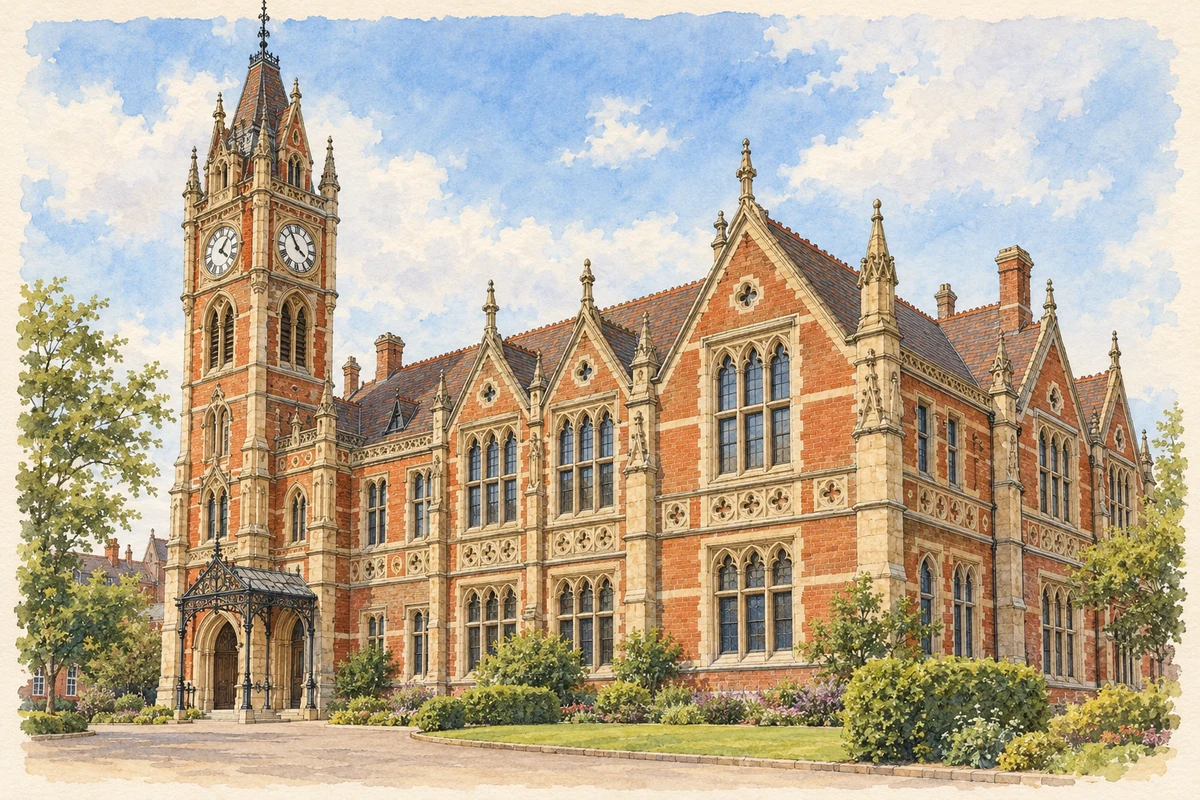
Original illustration of Burton upon Trent Town Hall by PlaceHistory. Original composition from inspected architectural facts; no source photograph copied or used as an image-edit input. Fine detail is interpretive, not a measured survey.
Original architectural composition based on the cited building descriptions; incidental setting and fine details are interpretive. Historic England: Burton Town Hall; Sika: Burton Town Hall conservation project
 Town
Stafford
Illustration credit
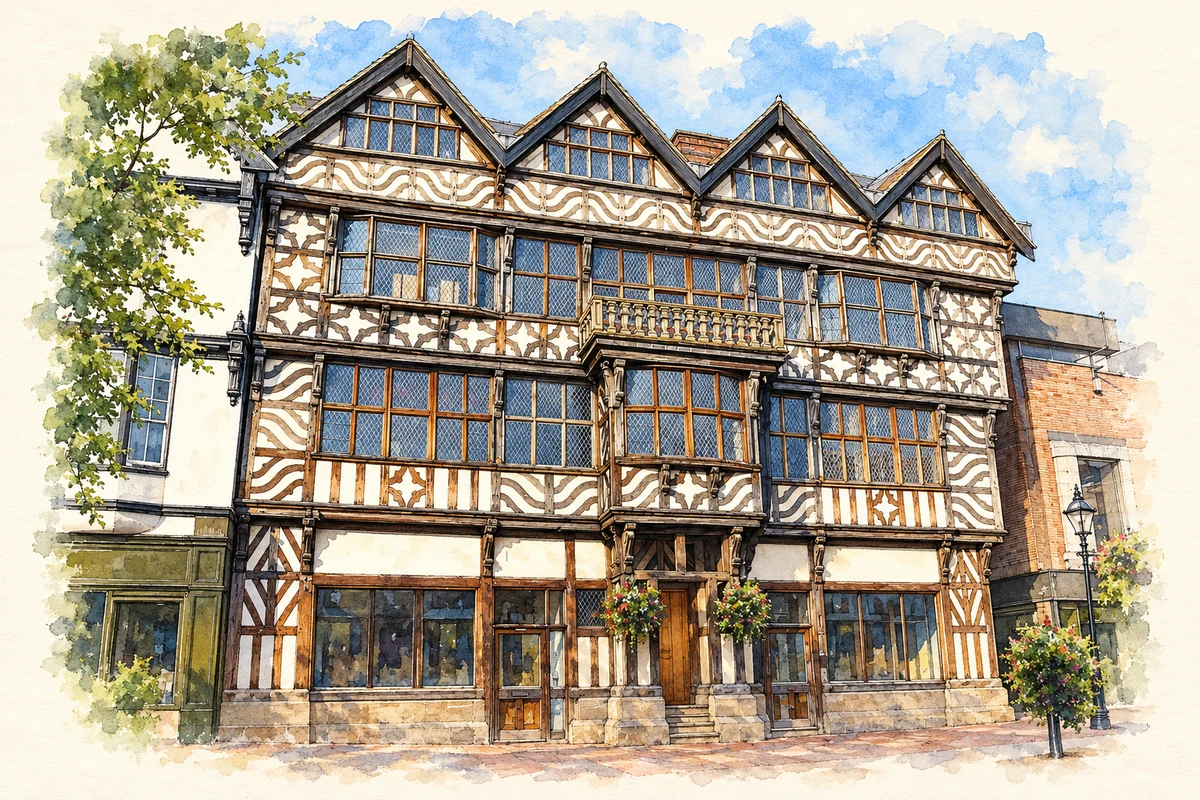
Illustration of The Ancient High House, Stafford, adapted from Stafford-ancient-high-house.jpg by Stocksy. Public domain. AI-assisted watercolour and fine ink adaptation; cream paper margins, simplified fine detail and removal of incidental street clutter.
 Town
Leek
Illustration credit
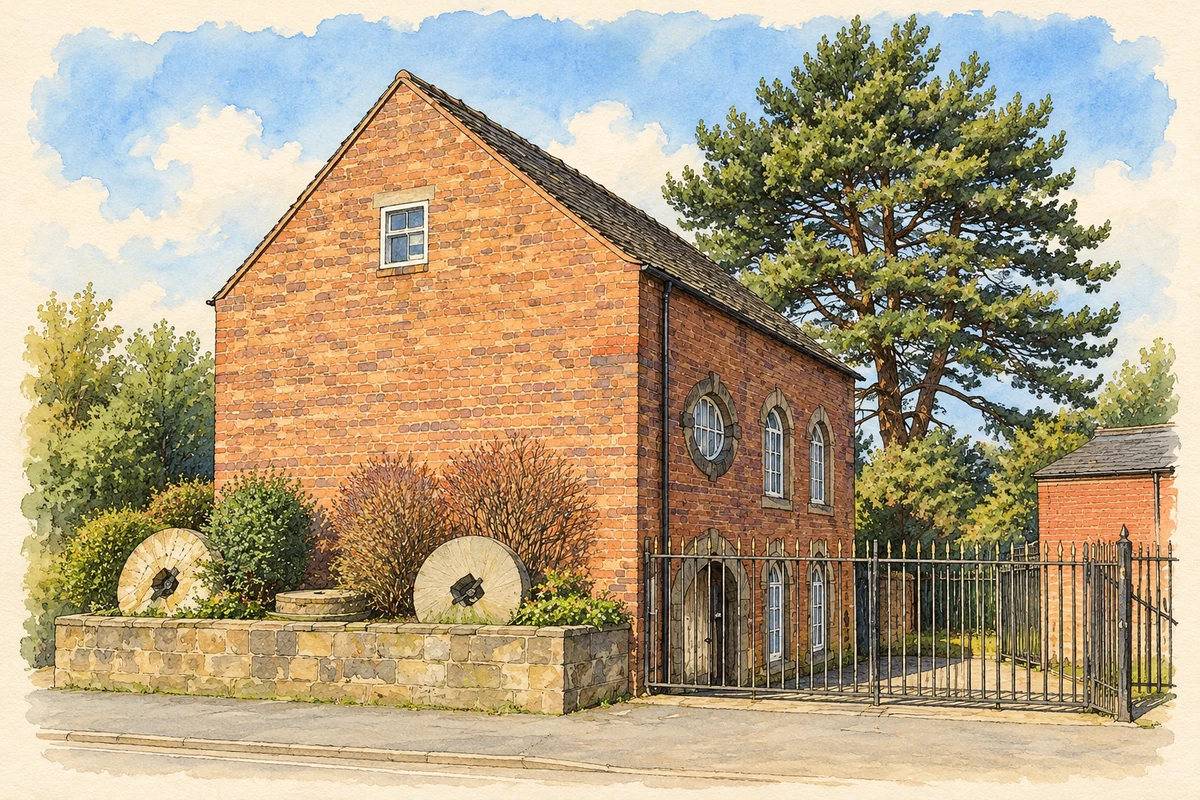
Illustration of Brindley's Mill, Leek, adapted from Brindley Mill 2019.jpg by AtticTapestry. CC BY-SA 4.0. AI-assisted watercolour and fine ink adaptation; incidental clutter simplified, warm cream paper margins. Architectural forms follow the inspected reference.
 Town
Tamworth
Illustration credit
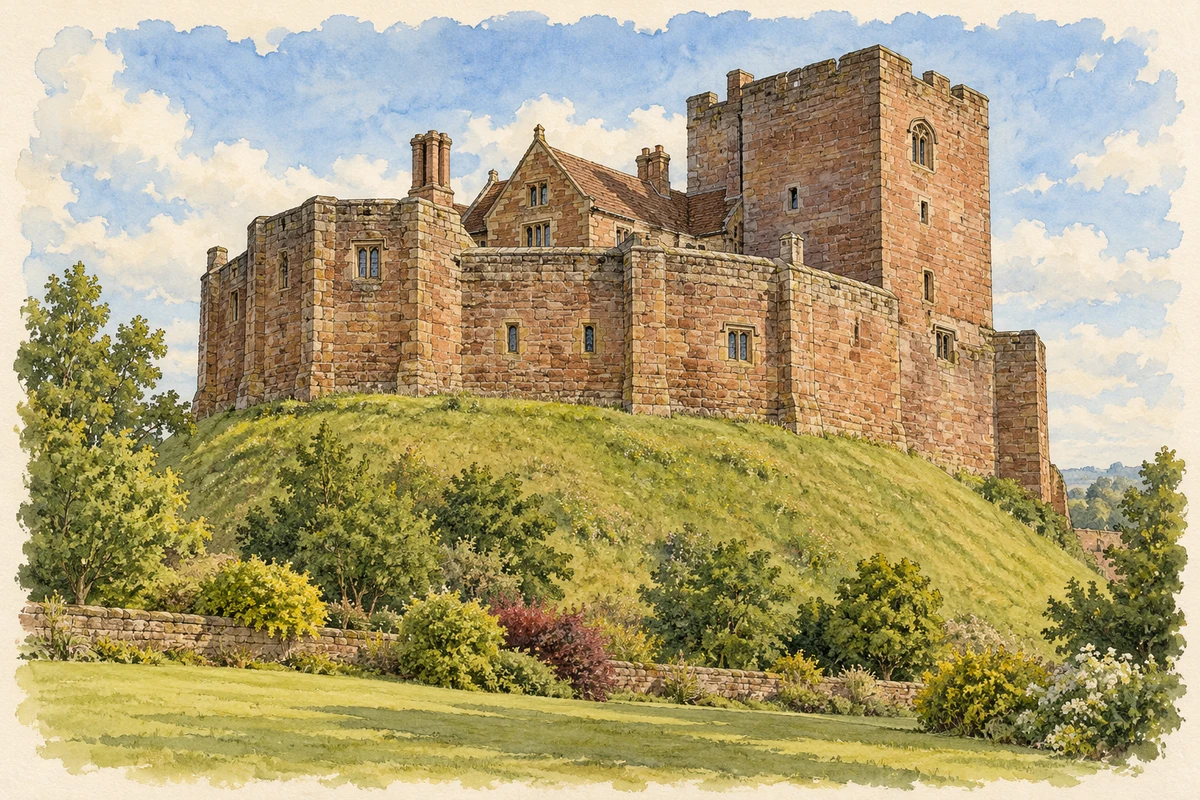
Original illustration of Tamworth Castle by PlaceHistory. Original composition from inspected architectural facts; no source photograph copied or used as an image-edit input. Fine detail is interpretive, not a measured survey.
Original architectural composition based on the cited building descriptions; incidental setting and fine details are interpretive. Historic England: Tamworth Castle; Tamworth Castle: access


Explore the area
This map shows the county browsing area used by PlaceHistory. Historic county boundaries and present-day councils can differ.
All places in Staffordshire
922 places. Entries labelled “Local history” have a researched account; directory entries provide maps and geographic records.
Showing up to 50 places, ordered by name.
- Hamlet
Bank Top
Directory entry - Village
Barlaston
Directory entry - Suburban area
Barlaston Common
Directory entry - Suburban area
Barnfields
Directory entry - Village
Barton Gate
Directory entry - Village
Barton Turn
Directory entry - Village
Barton-under-Needwood
Local history - Suburban area
Basford
Directory entry - Hamlet
Basford Green
Directory entry - Suburban area
Baswich
Directory entry - Suburban area
Beaconside
Directory entry - Hamlet
Beamhurst
Directory entry - Suburban area
Beasley
Directory entry - Village
Bednall
Directory entry - Other settlement
Bednall Head
Directory entry - Other settlement
Beech
Directory entry - Hamlet
Beechcliff
Directory entry - Hamlet
Beffcote
Directory entry - Suburban area
Belgrave
Directory entry - Hamlet
Bemersley Green
Directory entry - Suburban area
Bentilee
Directory entry - Suburban area
Berry Hill
Directory entry - Village
Betley
Directory entry - Hamlet
Bickford
Directory entry - Town
Biddulph
Local history - Village
Biddulph Moor
Directory entry - Village
Bignall End
Local history - Village
Bilbrook
Directory entry - Other settlement
Billington
Directory entry - Hamlet
Birch Cross
Directory entry - Village
Birchall
Directory entry - Suburban area
Birches Head
Directory entry - Village
Bishops Offley
Directory entry - Village
Bishops Wood
Directory entry - Hamlet
Bishton
Directory entry - Hamlet
Blackbrook
Directory entry - Hamlet
Blackbrook
Directory entry - Other settlement
Blackbrook
Directory entry - Suburban area
Blackfords
Directory entry - Village
Blackshaw Moor
Directory entry - Suburban area
Blackwaters
Directory entry - Hamlet
Blackwood Hill
Directory entry - Suburban area
Blakeley
Directory entry - Hamlet
Blakeley Lane
Directory entry - Hamlet
Blakelow
Directory entry - Village
Blithbury
Directory entry - Village
Blithfield
Directory entry - Other settlement
Blore
Directory entry - Other settlement
Blore
Directory entry - Suburban area
Blount's Green
Directory entry
Sources & further reading
- About local government reorganisation and devolution · Stoke-on-Trent City Council
- Local government reorganisation: Frequently asked questions, September2026 update · Lichfield District Council
- History of Stafford and Stafford Borough Council · Stafford Borough Council
- Wedgwood: An introduction · Victoria and Albert Museum
- Stoke-on-Trent: Celebrating100years as a city · Stoke-on-Trent City Council
- History of Lichfield · Lichfield City Council
- Celebration of Burton’s Heritage: Bass Day · Discover East Staffordshire / East Staffordshire Borough Council
- Landscape · Cannock Chase National Landscape
- The Chase Through Time · Cannock Chase National Landscape
- ONS December 2025 administrative boundaries
Last researched 2026-10-27. How we research our histories.