 place
Herefordshire
Hereford's defended river crossing, Marcher castles, wool markets and a former cider factory offer different routes into Herefordshire's history.
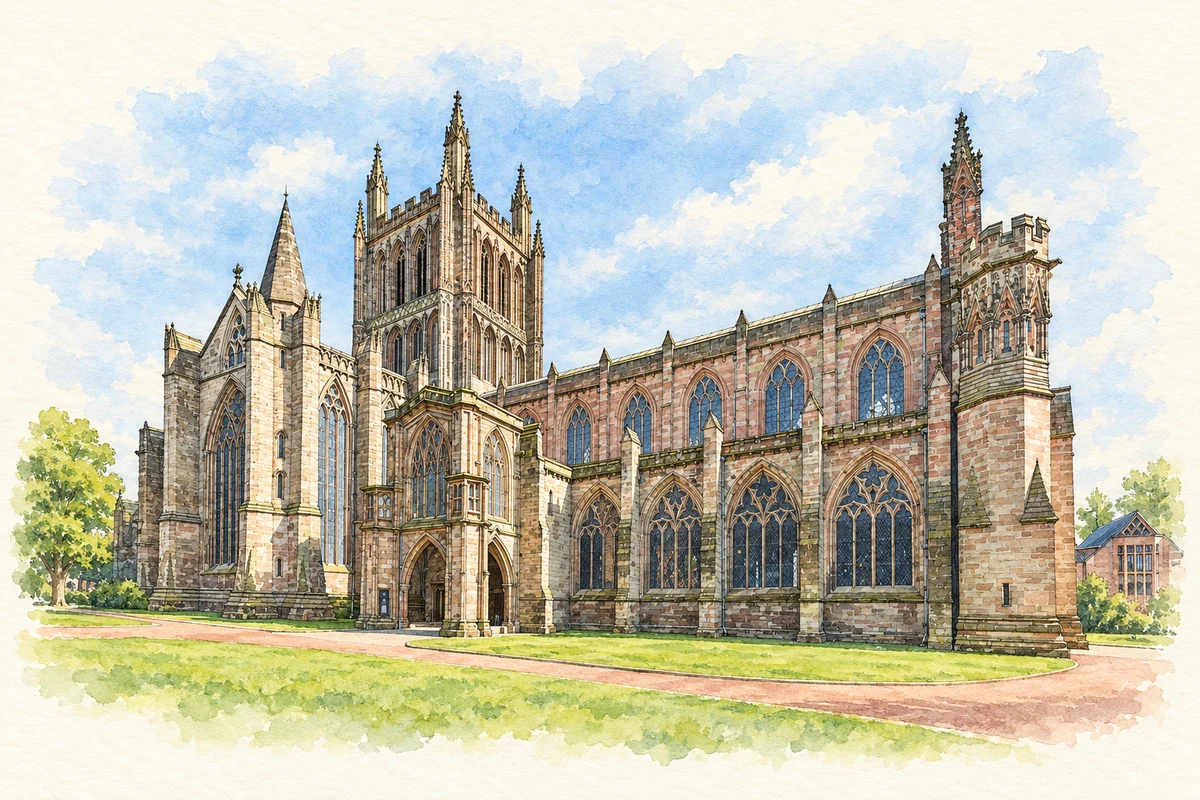
Illustration credit
Illustration of Hereford Cathedral, adapted from Hereford Cathedral Exterior from NW, Herefordshire, UK - Diliff.jpg by Diliff. CC BY-SA 3.0. AI-assisted watercolour and fine ink adaptation; cream paper margins, simplified fine detail and removal of incidental street clutter.

A history of Herefordshire
A county, a city and changing councils
Herefordshire's history reaches well beyond the life of its present council. Herefordshire Council was established in April 1998, taking over responsibilities from the combined Hereford and Worcester county council and several district authorities. The preceding county of Hereford and Worcester had been introduced in 1974. Hereford's city council was subsequently reconstituted as a parish council in 2000. The city, the wider county and their councils therefore describe different scales of place: a city council is not the authority for every Herefordshire village. [2] [3]
Hereford and the Wye crossing
Hereford offers a starting point for understanding the county's border history. Archaeological work in Victoria Street uncovered successive pre-Conquest defences, with a gravel rampart followed by a larger turf-and-clay defence. The council's archaeological account treats the earliest dating cautiously; the sequence matters more than attaching the whole town to one founder. At its centre, a route north from the Wye ford met an east–west route, with the cathedral within the defended area. [4]
The cathedral also connects this local landscape with medieval ideas about the wider world. Its Mappa Mundi, dated to about 1300, combines geography with religious history and images of people, animals and marvellous creatures. Jerusalem occupies the centre. It is a record of how medieval scholars represented the world, rather than a modern navigational map. Looking from the city's river crossing to this manuscript brings together the practical and intellectual roles of a cathedral town. [5]
Castles and the Marches
The western border brought distinctive systems of lordship as well as repeated conflict. Herefordshire Council's medieval overview explains how castles became administrative centres for Marcher lordships, whose lords exercised unusually extensive powers. The earthworks and surviving masonry should be read as instruments of government as well as military defences. Settlements could grow beside them: Kilpeck and Richards Castle are examples in the council's account of communities whose fortunes were tied to a castle economy. [6]
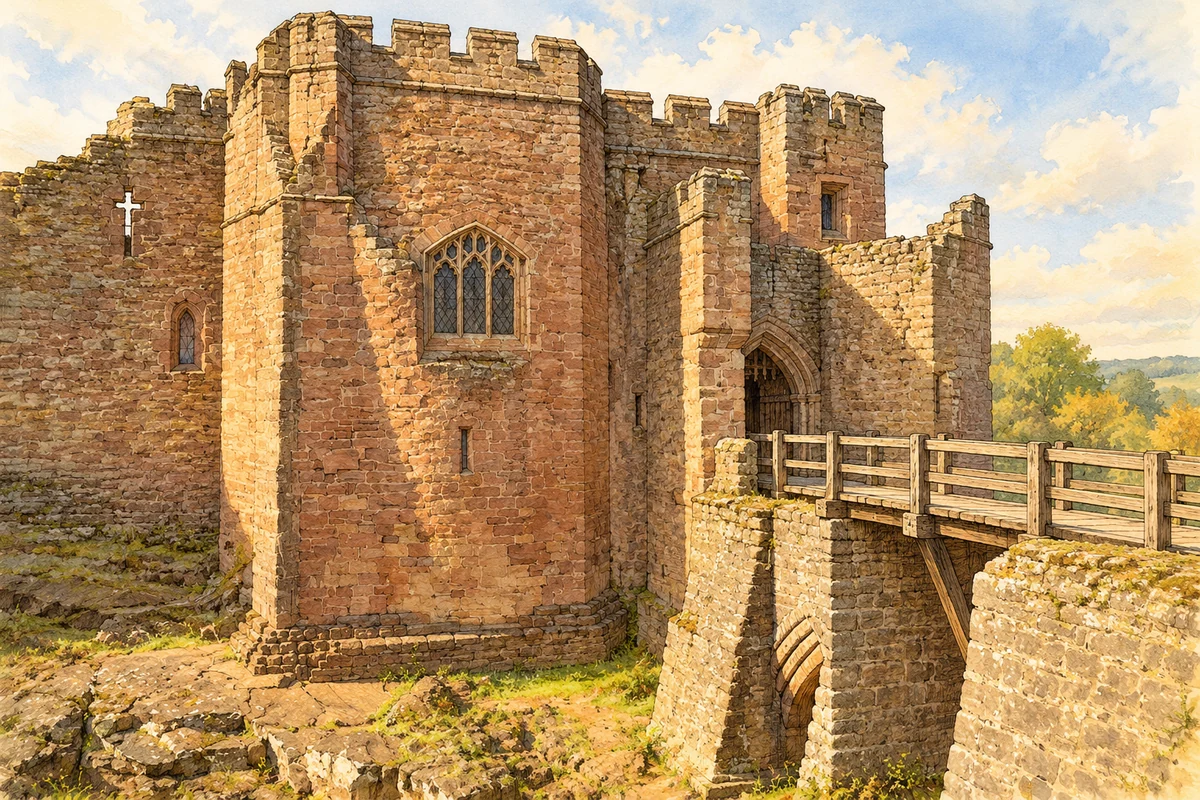
Goodrich provides a later, particularly visible episode. In the Civil War the castle became a Royalist stronghold under Henry Lingen. After Parliament captured Hereford in December 1645, Goodrich remained a base for Royalist operations. John Birch's forces besieged it in June and July 1646, using artillery, mines and the large mortar called Roaring Meg. Lingen surrendered on 31 July. Subsequent deliberate damage ensured that the castle could no longer serve as a fortress; the ruin records a seventeenth-century struggle within medieval walls. [7]
Wool, farming and market buildings
The county's rural economy was connected to trade through its towns. Medieval pasture supported sheep, while water was needed to process wool. Hereford handled wool from both the Marches and Wales, and Leominster was associated with the fine wool of Ryeland sheep. The council's account also describes the movement from open arable fields towards enclosed pasture during the later Middle Ages. These changes remind us that a familiar agricultural landscape has a history of altered crops, boundaries and livelihoods. [6]
Ledbury's Market House makes those trading connections tangible. Work began in 1617 on a timber-framed building raised on sixteen pillars, but completion took until 1668. Its upper rooms stored commodities including corn, wool, hops and acorns used in tanning. Later Victorian alterations introduced much of the staircase, flooring and windows seen today. The town council cautions that the popular attribution to carpenter John Abel lacks firm evidence. It is a good building through which to explore both commerce and the changing fabric of a market town. [8]
Cider as a preserved working history
Hereford's Museum of Cider offers another route into the relationship between country produce and town industry. The Hereford Cider Museum Trust was founded in 1973 after Bertram Bulmer and Norman Weston became concerned about the loss of cider-making history. Collecting objects and archives preceded the museum's opening in 1981 inside the old Bulmer's factory. Its setting makes the factory itself part of the story, alongside the tools and records preserved within it. [9]
The museum also records an attempt to revive cider distilling. After a dispute over licensing and terminology, Bertram Bulmer obtained a distilling licence in 1984 and equipped the museum's King Offa Distillery with a Normandy pot still made in 1905. The distillery no longer operates, but the surviving equipment extends the county's story beyond a picturesque orchard image to questions of manufacturing, regulation and the preservation of working knowledge. [9]
Places and their stories
A few of the 25 researched histories in this county.
- City
Hereford
Illustration credit
Illustration of Hereford Cathedral, adapted from Hereford Cathedral Exterior from NW, Herefordshire, UK - Diliff.jpg by Diliff. CC BY-SA 3.0. AI-assisted watercolour and fine ink adaptation; cream paper margins, simplified fine detail and removal of incidental street clutter.
 Town
Ledbury
Illustration credit
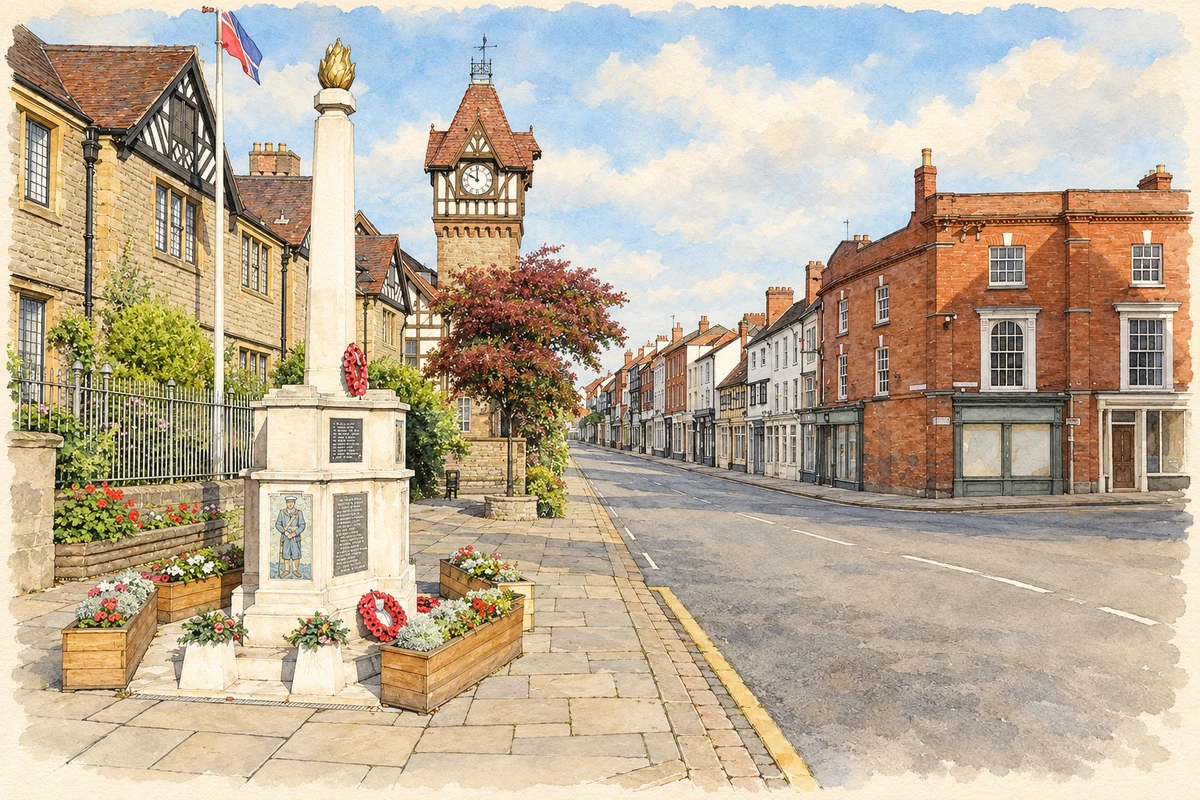
Illustration of Ledbury town centre, adapted from Centre of Ledbury - geograph.org.uk - 7301138.jpg by Philip Halling. CC BY-SA 2.0. AI-assisted watercolour and fine ink adaptation; cream paper margins, simplified fine detail and removal of incidental street clutter.
 Town
Ross-on-Wye
Illustration credit
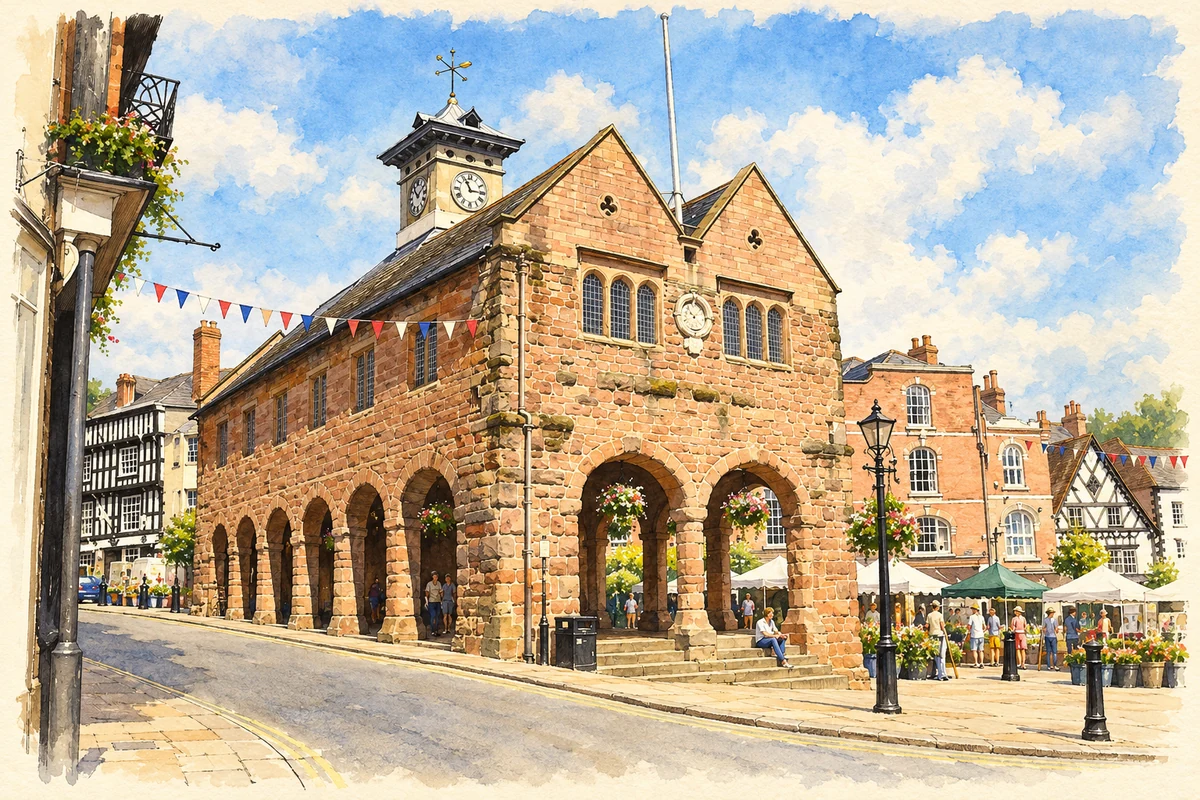
Illustration of Ross-on-Wye Market House, adapted from Market House, Ross on Wye - geograph.org.uk - 4604580.jpg by John Winder. CC BY-SA 2.0. AI-assisted watercolour and fine ink adaptation; incidental clutter simplified, warm cream paper margins. Architectural forms follow the inspected reference.
 Town
Leominster
Illustration credit
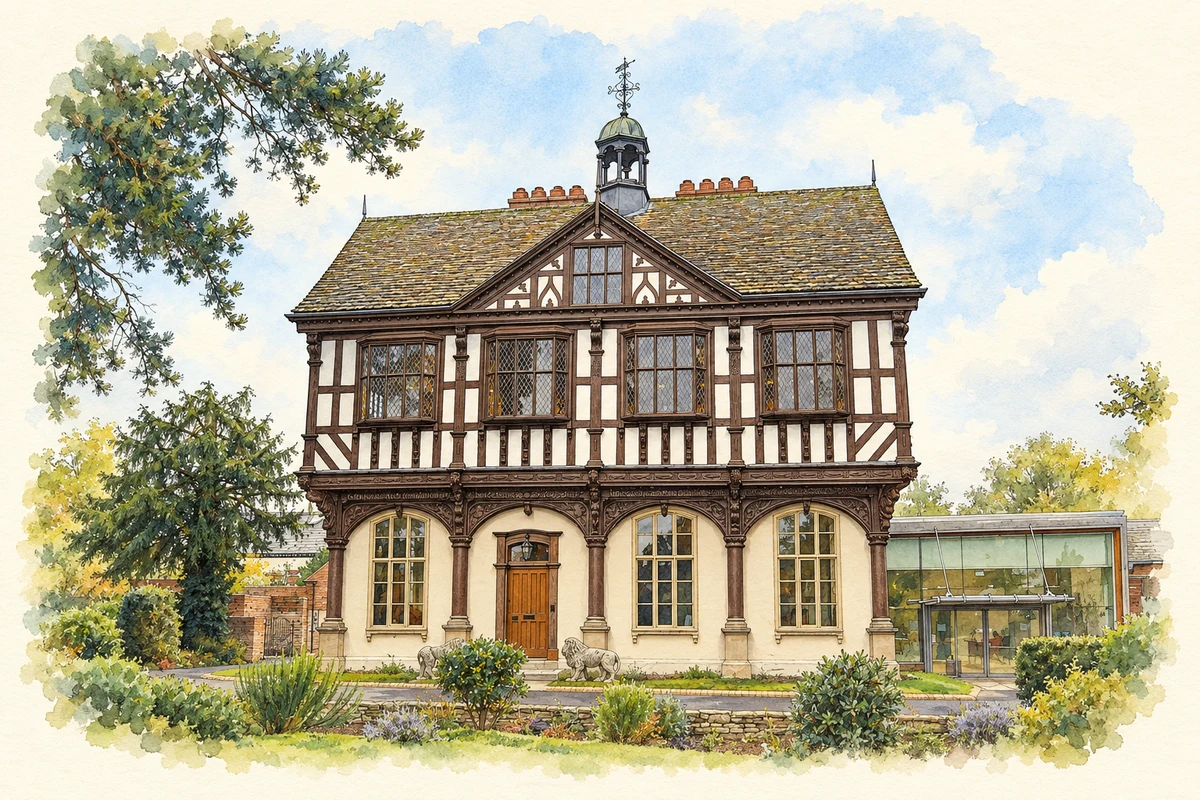
Illustration of Grange Court, Leominster, adapted from Grange Court, Leominster - 2013-11-15 - Andy Mabbett - 02.jpg by Andy Mabbett. CC BY-SA 3.0. AI-assisted watercolour and fine ink adaptation; cream paper margins, simplified fine detail and removal of incidental street clutter.
 Village
Goodrich
Illustration credit
Illustration of Goodrich Castle gatehouse and chapel tower, adapted from Gatehouse of Goodrich Castle - geograph.org.uk - 5162389.jpg by Philip Halling. CC BY-SA 2.0. AI-assisted watercolour reconstruction from licensed present-day photograph; interpreted missing parapets, glazing, concealed roofs and timber approach.
Artistic reconstruction · Around 1500. Interpreted gateway before Civil War damage; surviving geometry retained, missing parapets and timberwork restored. Exact lost parapets, roof carpentry and bridge timberwork remain artistic interpretations. Tight gatehouse/chapel view; no reconstruction of unseen castle ranges. Goodrich Castle: scheduled monument Details; Goodrich Castle: listed building Details
 Village
Kilpeck
Illustration credit
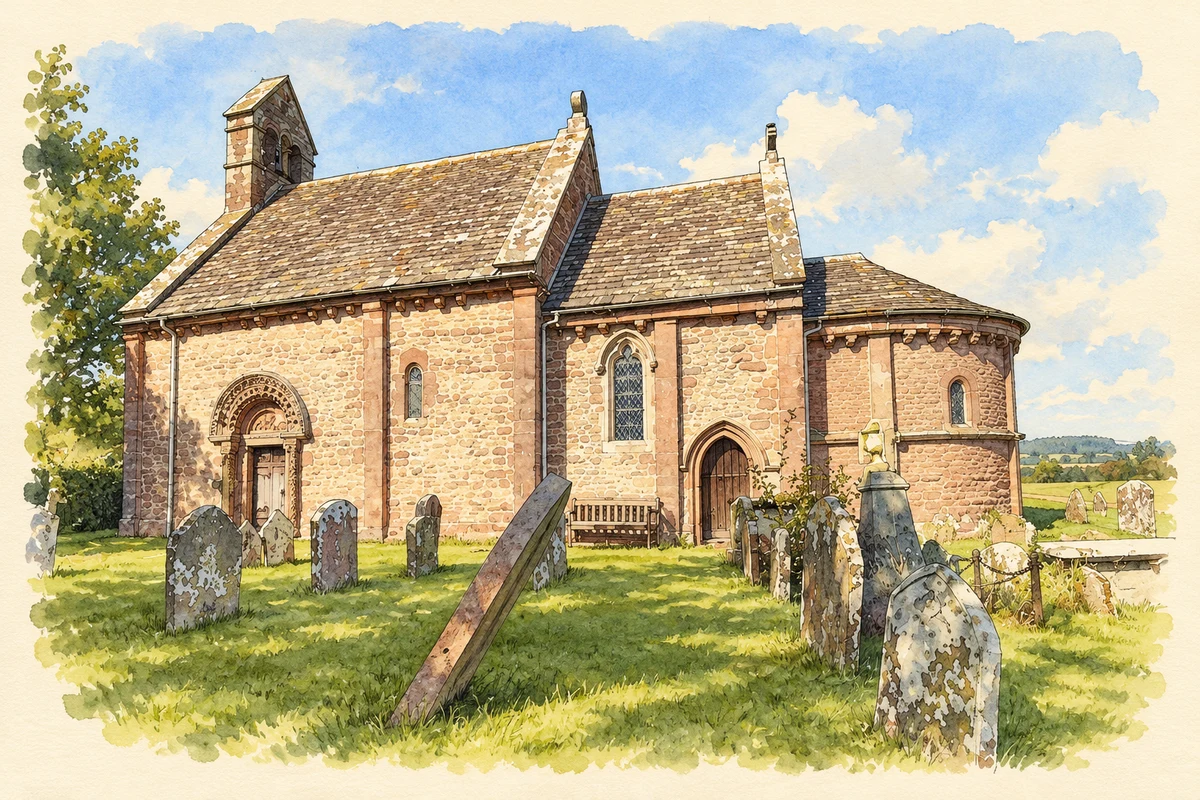
Illustration of St Mary and St David’s Church, Kilpeck, adapted from Kilpeck Church by AJD. CC BY-SA 2.0. AI-assisted watercolour and fine ink adaptation; simplified fine detail and removal of incidental clutter.


Explore the area
This map shows the county browsing area used by PlaceHistory. Historic county boundaries and present-day councils can differ.
All places in Herefordshire
669 places. Entries labelled “Local history” have a researched account; directory entries provide maps and geographic records.
Showing up to 50 places, ordered by name.
- Village
Abbey Dore
Local history - Other settlement
Aconbury
Directory entry - Hamlet
Acton Beauchamp
Directory entry - Hamlet
Acton Green
Directory entry - Village
Adforton
Directory entry - Hamlet
Adley Moor
Directory entry - Hamlet
Ailscroft
Directory entry - Hamlet
Allensmore
Directory entry - Village
Almeley
Directory entry - Hamlet
Almeley Wootton
Directory entry - Other settlement
Amberley
Directory entry - Suburban area
Archenfield
Directory entry - Hamlet
Archenfield
Directory entry - Other settlement
Arrow Green
Directory entry - Suburban area
Ashfield
Directory entry - Hamlet
Ashley Moor
Directory entry - Village
Ashperton
Directory entry - Hamlet
Ashton
Directory entry - Hamlet
Aston
Directory entry - Hamlet
Aston Crews
Directory entry - Village
Aston Ingham
Directory entry - Hamlet
Auberrow
Directory entry - Hamlet
Aulden
Directory entry - Suburban area
Aylestone Hill
Directory entry - Hamlet
Aylton
Directory entry - Hamlet
Aymestrey
Directory entry - Other settlement
Bacton
Directory entry - Other settlement
Bagwyllydiart
Directory entry - Village
Bailey Lane End
Directory entry - Village
Ballingham
Directory entry - Hamlet
Ballsgate Common
Directory entry - Suburban area
Barons Cross
Directory entry - Hamlet
Barrelhill Green
Directory entry - Village
Bartestree
Local history - Suburban area
Bartonsham
Directory entry - Hamlet
Baysham
Directory entry - Other settlement
Bearwood
Directory entry - Hamlet
Beavan's Hill
Directory entry - Hamlet
Becknell
Directory entry - Hamlet
Bellamore
Directory entry - Suburban area
Belmont
Directory entry - Hamlet
Bicton
Directory entry - Other settlement
Biddlestone
Directory entry - Hamlet
Birchall
Directory entry - Hamlet
Bircher
Directory entry - Hamlet
Birley
Directory entry - Hamlet
Birtley
Directory entry - Village
Bishops Frome
Directory entry - Village
Bishopstone
Directory entry - Suburban area
Blackmarstone
Directory entry
Sources & further reading
- About your council · Herefordshire Council
- Council History · Hereford City Council
- Hereford and its Saxon Origins · Herefordshire Council; Miranda Greene
- Mappa Mundi · Hereford Cathedral
- The Medieval period · Herefordshire Council; Miranda Greene
- The Siege of Goodrich Castle · English Heritage
- The Market House · Ledbury Town Council
- Museum History · Museum of Cider
- ONS December 2025 administrative boundaries
Last researched 2026-10-27. How we research our histories.